
Every table tennis team knows the scene. Twenty minutes before the match, in the changing room, somewhere between the warm-up and the line-up: one player has faced the opponents’ number three three times already and knows exactly that the backhand pimples only fold under pressure. He says so. The other nods. By the time they are at the table, half of it is gone again.
It is not that nobody takes notes. It is that the notes had nowhere to go. A photo of a notebook page is unreadable, nobody listens to a voice message to the end, and one player’s app is not installed on the other player’s phone.
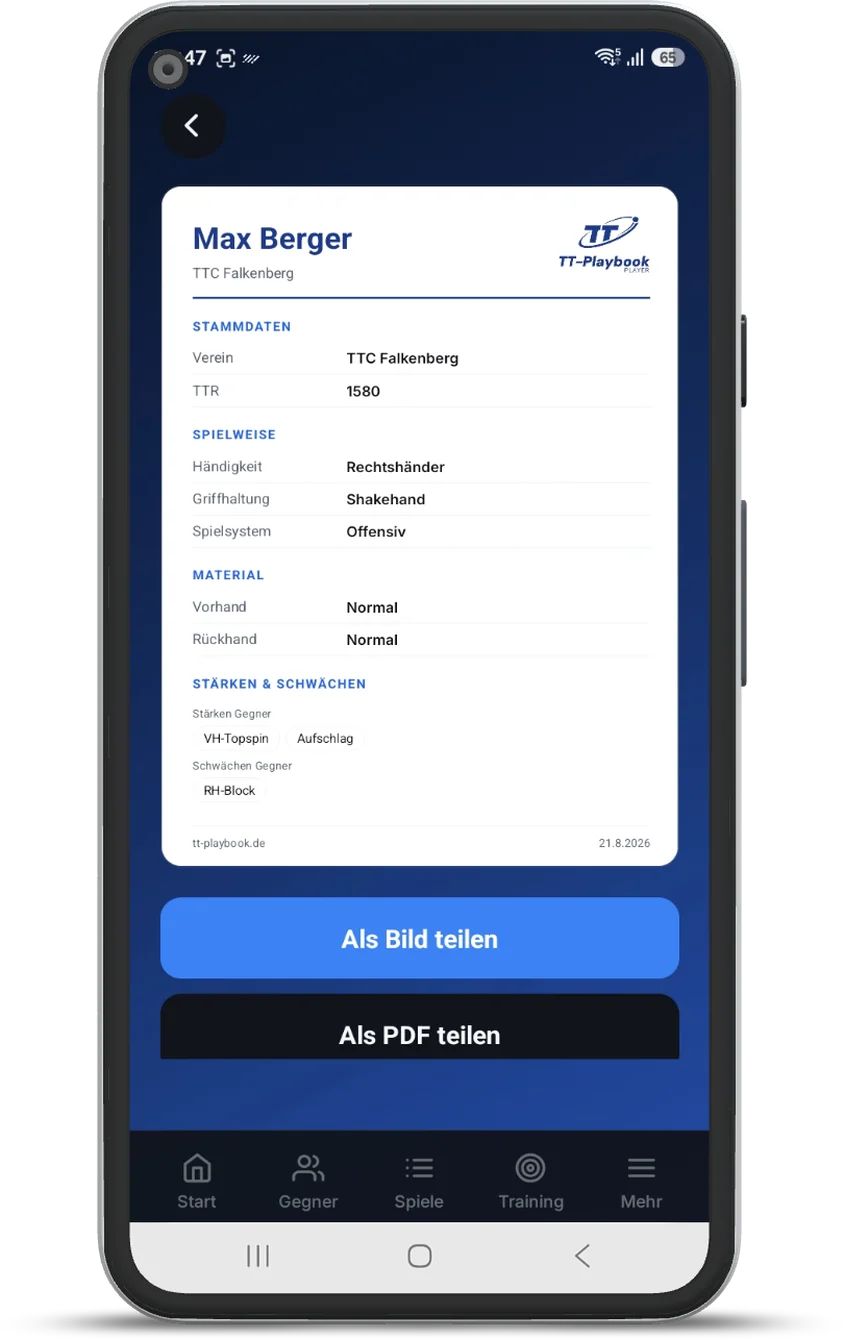
That is what the opponent profile sheet in TT Playbook Player is for: two taps turn any opponent profile into a sheet you can send — as an image into the team chat, or as a PDF by email.
One button in the opponent profile, that is all it takes
Nothing to collect, nothing to retype. The sheet is built from the opponent profile that is already in the app — club, team, rating, handedness, grip, playing system, the equipment down to rubber colour, plus the strength and weakness tags and your notes.
The opponent profile carries a second button underneath “Prepare match”: Share profile sheet. One tap and you are in the selection.
You decide every single time what goes with it
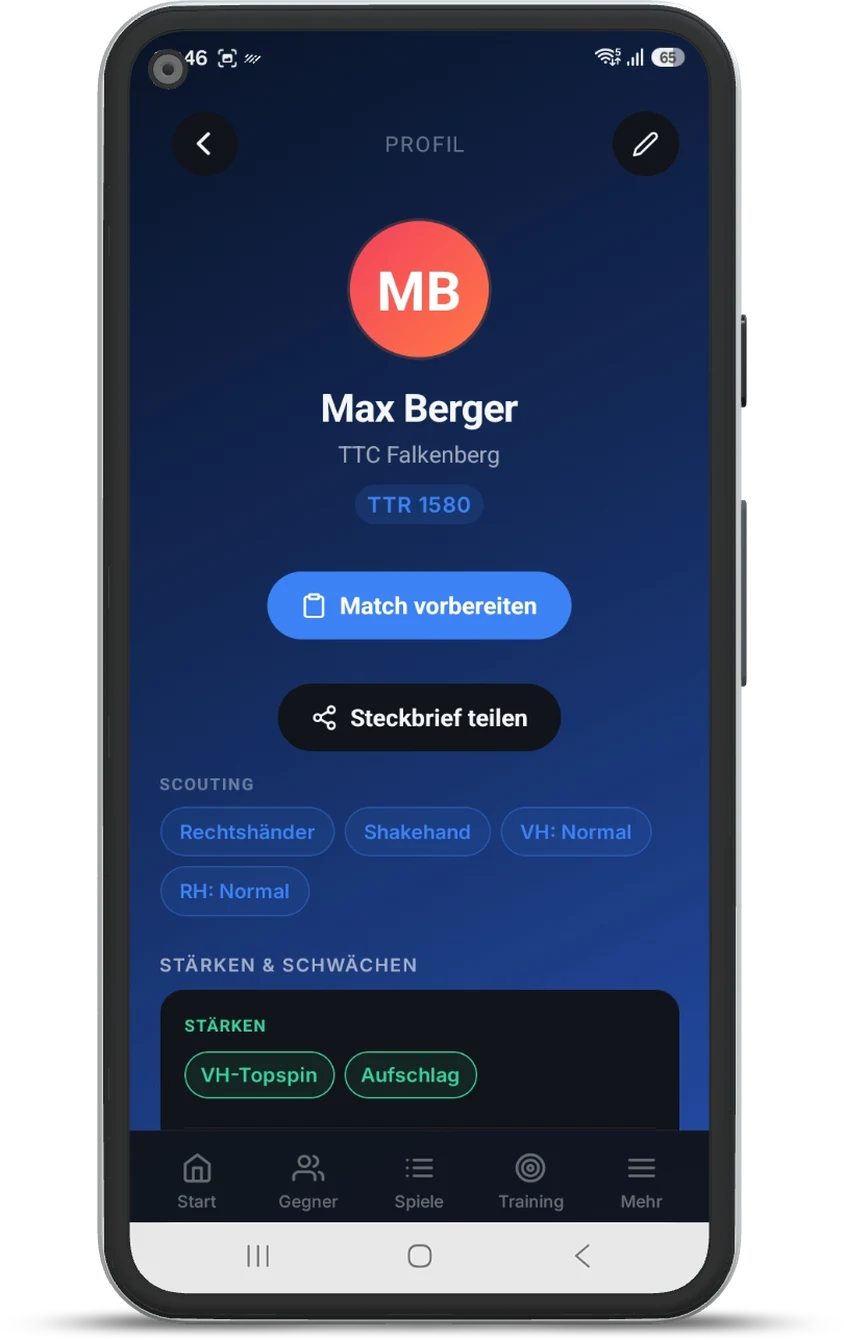
The page is called “What should be included?” and means it literally. Three switches, and below them a preview that changes immediately:
- Strengths & weaknesses — the structured tags from the profile. On by default.
- Notes — your own assessments, word for word, exactly as you wrote them. Off by default.
- Your record — your result against him. Off by default, because it says something about your matches, not about his level.
The basics, playing style and equipment are always included — they are what anyone in the hall can see anyway.
The second half of the sentence on notes is the important one: the switch remembers nothing. Next time you build a sheet it is off again. Free text about another person should stay a deliberate one-off decision, not a setting you eventually forget about.
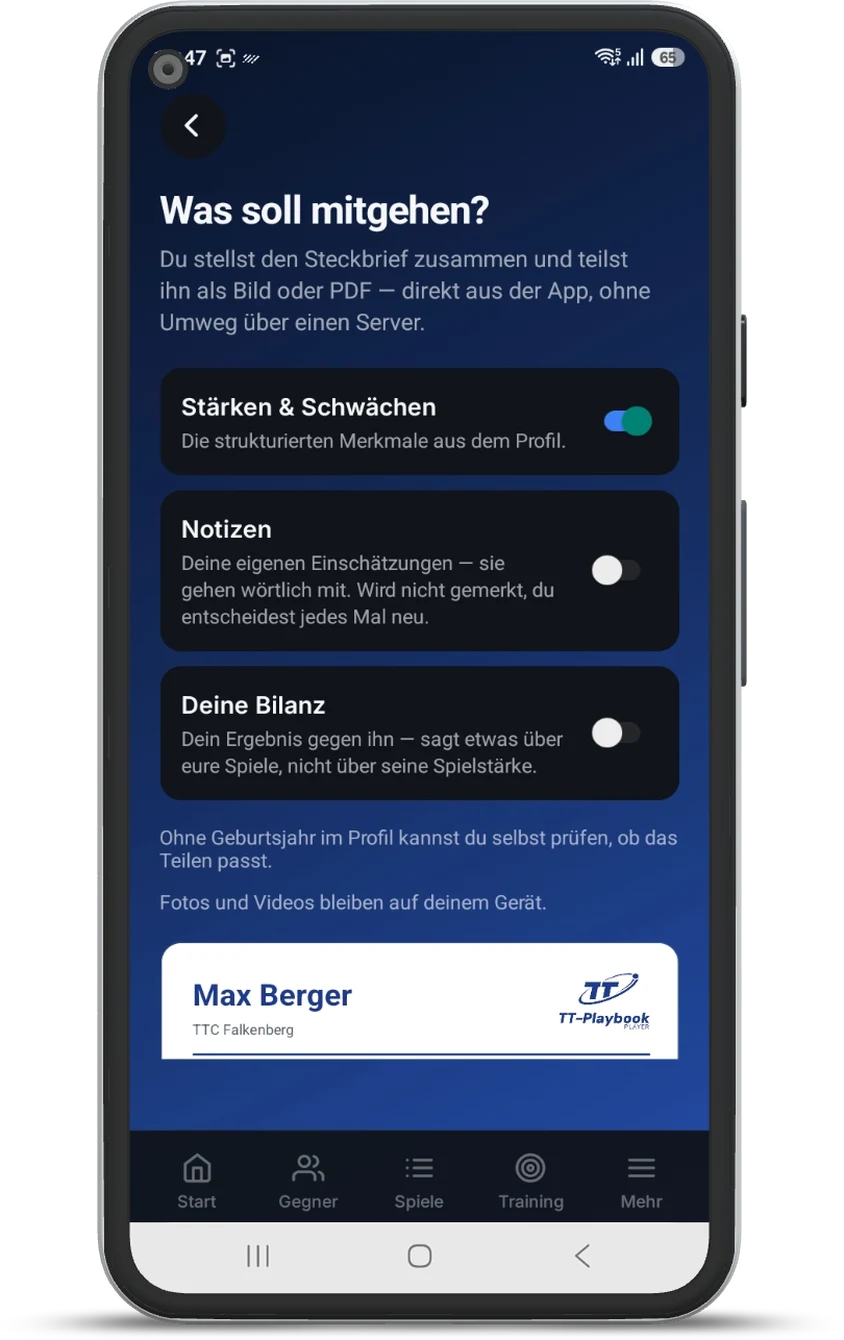
Image or PDF — a card anyone can read
What comes out is deliberately a card, not a dossier: the name large at the top, then basics, playing style, equipment, strengths and weaknesses in clear blocks. Always light, even when your app runs in dark mode. The sheet has to work on any screen, and on paper just as well.
Then you choose: Share as image goes into your phone’s share sheet and on from there to WhatsApp, Signal or the team group. Share as PDF gives you one page that fits in any email.
The recipient needs neither the app nor an account. They get an image or a PDF like any other.
At the bottom sit the date and tt-playbook.de. Nothing else — no sender, no name, no identifier.
What stays on your device
The profile sheet is a file — no account, no pool, no database. Two things are built in for that reason:
- Nothing is uploaded. No server, no link, no copy on our side. The file is created on your device and goes straight into the share sheet.
- Photos and videos never travel. Not as an option, not as a switch — they stay with you.
Our advice, and it is in the app too: share with people you know, and share what you observed yourself in competition.
The table tennis app is available for iPhone and Android:
Who this was built for
- Team captains planning the line-up before a league match, who want to know who has the better cards against whom.
- Teams with mixed experience — the veteran passes his knowledge to the junior without having to tell the story three times.
- Coaches preparing their players for specific opponents.
- Players in several teams, who face the same field twice a year.
Whether the app suits your game at all is answered in Who is TT Playbook for.
New prices, a bigger free plan
The profile sheet is part of Pro. And since this is the right moment to say it: Pro now costs half.
€4.90 per month or €39 per year — it used to be €9.90 and €99. The reason is simple: the old price did not fit an app you use a few times a week in a sports hall. Better a price nobody has to think about for long.
At the same time the free plan has grown considerably. It used to be too tight — five opponents and twenty matches last a few weeks, not a season. And anyone who puts an app aside after three weeks does not come back. The plan now is:
- 20 opponent profiles instead of 5
- 100 matches instead of 20
- The first statistics section, Record & form, is open to everyone. Not as a locked preview, but in full.
- Match preparation can be tried with three different opponents. An opponent you have opened once can be reopened as often as you like.
That is enough for a whole half-season. Anyone who wants more after that knows exactly what for — every limit and feature is listed on the Player app page.
The table tennis app for iPhone and Android
The profile sheet is part of the current update. If you already have the app it arrives the usual way — and the app will point it out on your next launch.
If you are not on board yet: install it, add a few opponents, and before the next league match you will not be looking around the changing room but at your phone.
Why simply training harder is not enough is covered in Why hard training does not automatically make you better.